
Welcome to Your Ultimate Irish Pub Guide
The Irish pub is legendary worldwide, but stepping into one in Ireland is an entirely different experience. These are places where time slows down, laughter fills the air, and every stranger feels like a friend. If you are looking for the definitive Irish pub guide, you have come to the right place. From lively music sessions in Galway to quiet, historic pubs in Dublin, each establishment has its own unique personality and story to tell.
There is nothing quite like pushing open the heavy wooden door of an authentic tavern, hearing the clinking of glasses, and smelling the faint aroma of peat from an open fire. In this Irish pub guide, we will walk you through exactly what makes an Irish pub so special and how you can experience it like a true local.
When planning a trip to the Emerald Isle, the landscape and historical ruins are often at the top of the itinerary. Yet, any seasoned traveler will tell you that the true heart and soul of Ireland is found within the four walls of its local pubs.
A pub is not merely a drinking establishment; it is an institution, a community center, a confessional, and a stage for the country’s finest storytellers and musicians. Whether you are seeking refuge from the famous Irish rain or looking to celebrate a victorious sports match with locals, the pub is the ultimate destination.
This comprehensive Irish pub guide is designed to take you on a deep dive into the culture, history, and unspoken rules of these magical places. By the time you finish reading this Irish pub guide, you will know exactly what to order, how to behave, and where to find the most authentic experiences from the bustling streets of Dublin to the remote peninsulas of the Wild Atlantic Way.
A pub in Ireland is a great equalizer. It does not matter if you are a local politician, a farmer, a tech executive, or a tourist passing through; once you step inside, everyone is on the same level.
The sense of camaraderie is palpable, and it is very common to walk in alone and leave a few hours later with a handful of new friends. This inclusive atmosphere is perhaps the most defining characteristic of the Irish pub, setting it apart from bars in almost any other country in the world. Our Irish pub guide will help you navigate this wonderful social dynamic.
The Rich History and Evolution of the Irish Pub
To truly appreciate the modern Irish pub, one must first look back at its storied past. The word ‘pub’ is short for ‘public house,’ a term that accurately describes its function for centuries.
Historically, these venues were exactly that—houses open to the public where locals could gather to discuss the day’s events, trade gossip, and find warmth. As noted in any good Irish pub guide, dating back over a millennia, the oldest recorded pub in Ireland (and potentially the world) is Sean’s Bar in Athlone, which boasts a history stretching back to the year 900 AD.
Excavations at the site have revealed ancient wattle and daub walls, and records show that the site has been serving drinks for over eleven centuries. The Brazen Head in Dublin followed closely, opening its doors in 1198. These ancient establishments began as alehouses and inns, providing weary travelers and local merchants with basic sustenance, a safe place to rest, and a chance to exchange news.
By the 18th and 19th centuries, the ‘spirit grocery’ emerged as a distinctly Irish phenomenon. Due to strict licensing laws, many shopkeepers combined their grocery or hardware businesses with a bar.
It was entirely common to purchase a pound of nails, a sack of flour, and a pint of stout all over the same wooden counter. Even today, you can find traditional pubs, especially in rural areas like County Kerry or County Clare, that still display shelves of vintage groceries or hardware supplies as a nod to this fascinating era, a detail we love to highlight in this Irish pub guide.
During the struggle for Irish independence, pubs also served as clandestine meeting places for revolutionaries and political figures. The walls of many historic Dublin pubs have absorbed conversations that literally shaped the destiny of the nation.
Michael Collins, Eamon de Valera, and countless other historical figures utilized the back rooms and snugs of local pubs to plan, debate, and organize. When you step into one of these older establishments, you are not just walking into a bar; you are stepping into a living, breathing museum of Irish history.
Furthermore, pubs were often the only places in rural communities with a functioning telephone or television in the early 20th century. Locals would gather in the pub not just to drink, but to make important phone calls, watch major sporting events, or hear the news from the outside world. This cemented the pub’s status as the absolute center of community life, a status that many rural pubs still proudly hold today.
Architecture and Atmosphere: What to Expect
There is a distinct aesthetic that defines a true Irish pub, an atmosphere that cannot be easily replicated by the countless ‘Irish-themed’ bars found across the globe. Authentic pubs are characterized by their warmth, intimacy, and a sense of timelessness.
The layout is usually divided into small, cozy areas known as ‘snugs.’ Historically, snugs were private compartments with their own serving hatch to the bar, allowing patrons—often women, clergy, or the local police—to enjoy a drink in privacy without being observed by the main patrons.
These snugs often featured frosted glass windows and heavy wooden doors. Today, snagging a seat in the snug is considered a stroke of luck and provides the perfect intimate setting for a group of friends to spend an evening in deep conversation. It is a highly recommended experience in our Irish pub guide.
Visually, expect dark, heavy woods—mahogany or oak—that have been polished smooth by the elbows of countless generations. The floors are often tiled with beautiful, intricate mosaic patterns, or made of worn wooden floorboards that creak reassuringly underfoot.
The walls are typically adorned with eclectic memorabilia: vintage whiskey mirrors, antique clocks, black-and-white photographs of local legends, and perhaps a dusty hurley stick or a fiddle hanging from the rafters. A genuine Irish pub does not look ‘designed’; it looks accumulated, a collection of memories gathered over decades or centuries.
Lighting is another crucial element. You will rarely find bright, harsh lighting in an authentic pub. Instead, the space is illuminated by soft, warm lamps, often with stained glass shades, and the flickering glow of a real turf or wood fire.
The fire is the focal point of many rural pubs, drawing patrons in from the cold and providing a natural gathering spot. As mentioned earlier in this Irish pub guide, perhaps the most crucial element of the atmosphere is the absence of blaring televisions (unless there is a major GAA, rugby, or soccer match on) and loud, intrusive pop music.
The soundtrack of an Irish pub is the hum of conversation, the clinking of pint glasses, and the spontaneous eruption of live traditional music. It is an environment designed explicitly for talking, listening, and connecting with the people around you.
The Heartbeat of the Pub: Traditional Irish Music Sessions
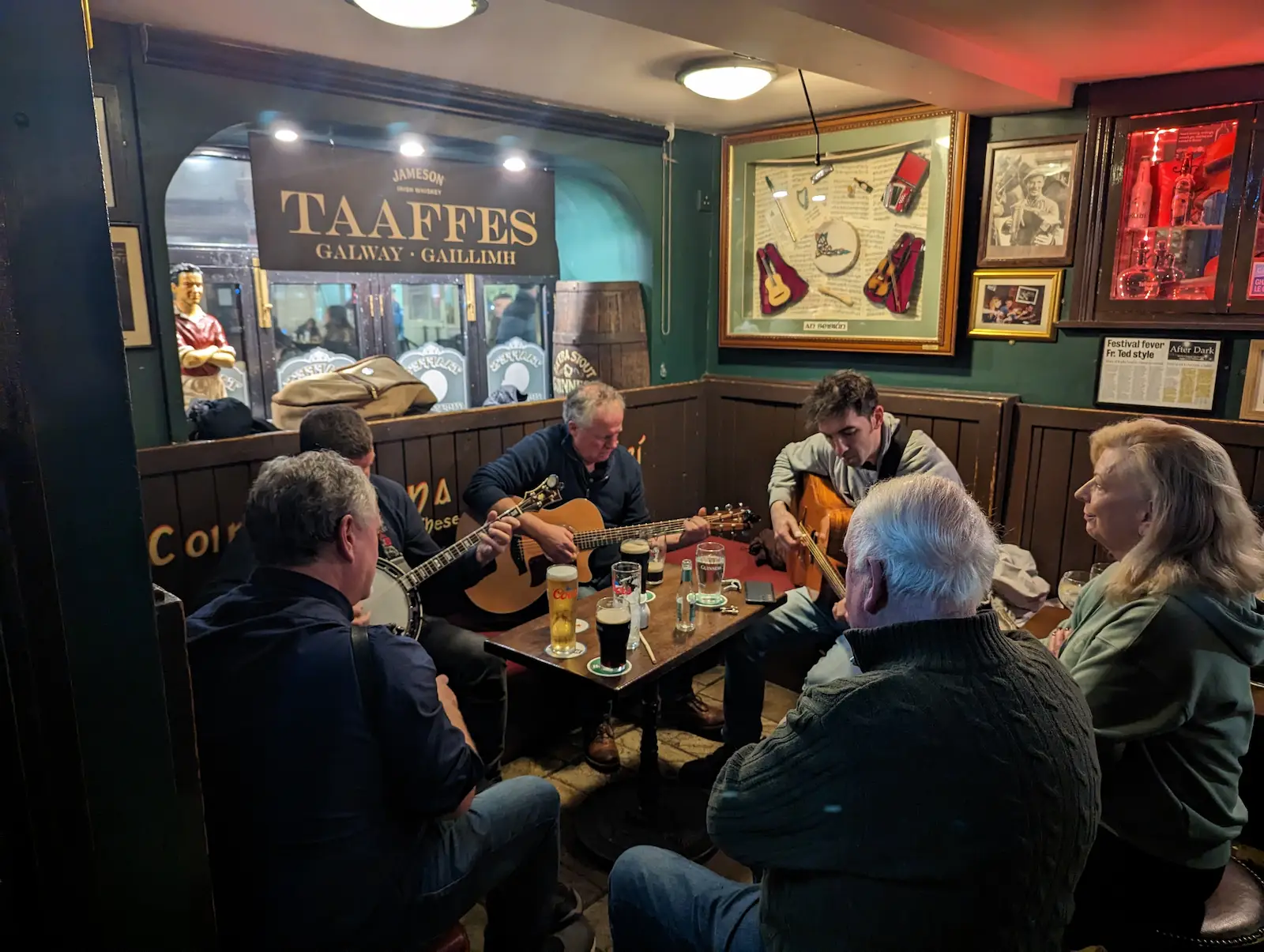
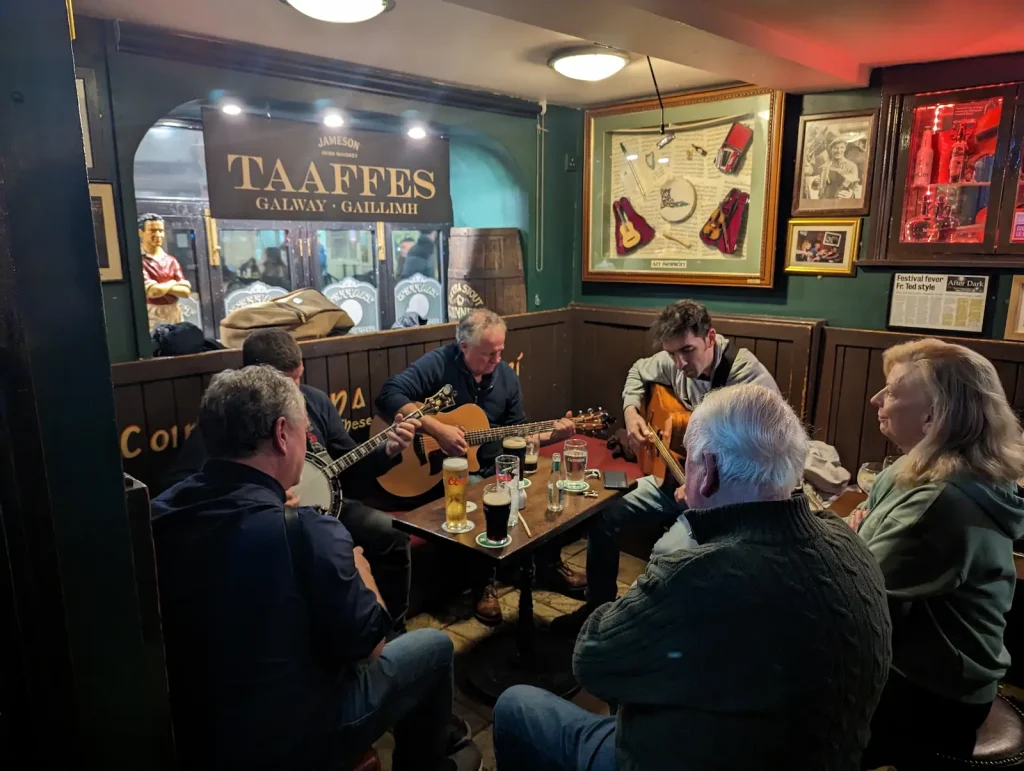
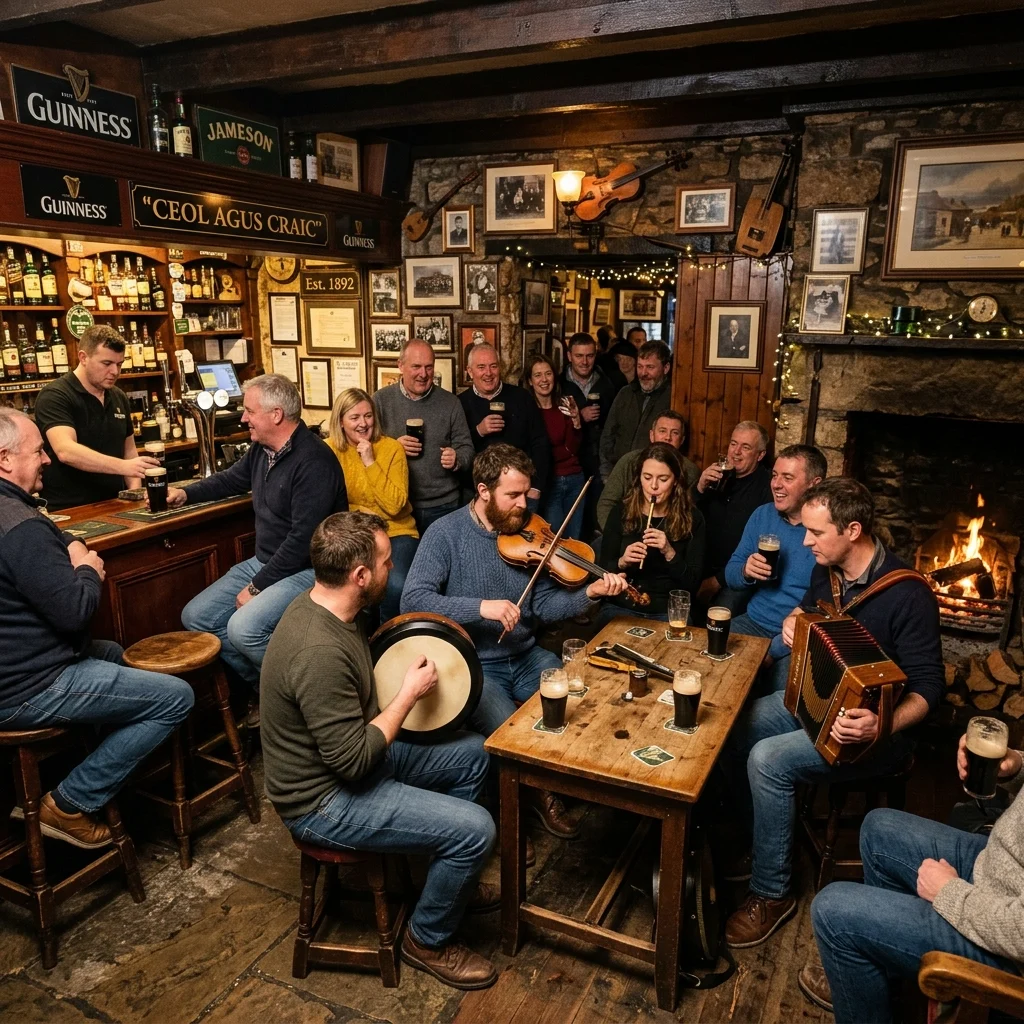
A true highlight of any Irish pub guide is the live music. Known as ‘trad sessions,’ these musical gatherings are the lifeblood of pub culture, particularly in the west of Ireland in places like Galway, Doolin, and Dingle.
A trad session is not a formal concert. There is no stage, no setlist, and rarely a microphone. Instead, local musicians gather in a corner of the pub—often in a reserved section—and simply start playing. Instruments typically include the fiddle, the tin whistle, the flute, the bodhrán (a traditional goatskin drum), the accordion, and the uilleann pipes.
These sessions are organic and fluid. A musician might start a tune, and others will seamlessly join in. The music ranges from lightning-fast jigs and reels that will have the entire pub tapping their feet, to slow, haunting airs that command absolute silence from the room.
Occasionally, a musician or a local patron might sing a ballad—a story of love, loss, rebellion, or emigration. When someone stands up to sing, it is customary to stop talking and listen; offering your full attention is a profound mark of respect.
The beauty of a trad session lies in its spontaneity. You never know exactly who is going to show up to play, or what tunes will be played. It is a living, breathing tradition passed down through generations.
Many of the tunes played in pubs today have been played for hundreds of years, learned by ear and passed from parent to child. Our Irish pub guide encourages you to just sit back and absorb the incredible talent on display.
If you play an instrument yourself, you might wonder if you can join in. The general rule is to ask permission or wait to be invited. Sessions are often informal, but they are also a tight-knit community practice. Some sessions are ‘open,’ meaning anyone can join, while others are ‘closed’ or by invitation only. Pulling up a chair, ordering a pint, and listening with appreciation is the best way to experience the magic of a trad session.
The Drinks: Beyond the Perfect Pint of Guinness
While it is impossible to write an Irish pub guide without mentioning Guinness, the drink menu in a traditional pub offers much more than just the famous black stuff. However, let us address the stout first.
The Art of the Pint
Ordering a Guinness in Ireland is a ritual. It is a known fact that Guinness simply tastes better in Ireland, a phenomenon attributed to the freshness of the kegs, the short distance from the St. James’s Gate Brewery, and the meticulous care publicans take in cleaning their draft lines.
A proper pint of Guinness is poured in two stages. The bartender will fill the glass three-quarters full, holding it at a 45-degree angle. They will then let it sit on the counter to ‘settle’—a mesmerizing process where the nitrogen bubbles cascade downward, creating a creamy white head.
Only after it has completely settled will they top it off. The entire process takes exactly 119.5 seconds. The golden rule in this Irish pub guide: never reach for your pint until the bartender presents it to you, fully settled.
While Guinness is the most famous, other stouts like Murphy’s and Beamish (particularly popular in Cork) are absolutely worth trying. They offer slightly different flavor profiles, often described as sweeter or more coffee-forward than Guinness.
Irish Whiskey: The Water of Life
The word ‘whiskey’ comes from the Irish phrase ‘Uisce Beatha,’ meaning the ‘water of life.’ Ireland is experiencing a massive renaissance in whiskey distilling.
While legacy brands like Jameson, Bushmills, and Tullamore D.E.W. remain staples, look out for premium offerings like Redbreast 12 Year Old, Green Spot, or Teeling. A true publican will be more than happy to guide you through a tasting.
Whiskey is typically ordered ‘neat’ (no ice) or with a small drop of water to open up the flavors. Unlike Scottish whisky, which is often peated and smoky, Irish whiskey is generally triple-distilled, resulting in a smoother, more approachable flavor profile with notes of vanilla, honey, and toasted wood.
Craft Beer and Cider
In recent years, the Irish craft beer scene has exploded. If stout isn’t your preference, you will find a fantastic array of locally brewed pale ales, IPAs, and red ales. Brands like Galway Bay Brewery, O’Hara’s, and Kinnegar are excellent choices, offering everything from crisp lagers to complex double IPAs.
Additionally, Irish cider, notably Bulmers (known as Magners outside the Republic of Ireland) or craft options like Stonewell, are incredibly popular, especially on a rare, sunny summer afternoon, typically served over ice.
Gin has also seen a massive surge in popularity across Ireland. Many pubs now boast extensive gin menus, featuring local Irish gins like Drumshanbo Gunpowder Irish Gin, Dingle Gin, and Glendalough, usually served in large balloon glasses with premium tonic and specific garnishes like fresh grapefruit or juniper berries.
Authentic Pub Grub: A Culinary Journey
The days when an Irish pub only served packets of crisps (potato chips) and salted peanuts are long gone. Today, many pubs boast excellent kitchens serving hearty, comforting, and high-quality food that showcases incredible local ingredients.
When scanning the menu, look for classic staples. Beef and Guinness stew is a rich, savory dish where the meat is slow-cooked until tender in a gravy infused with stout, usually served with creamy mashed potatoes.
Fish and chips feature freshly caught cod or haddock encased in a crispy, golden batter, accompanied by thick-cut chips, mushy peas, and tartar sauce. This is a highly recommended dish in our Irish pub guide.
Seafood chowder is another must-try, particularly in coastal towns along the Wild Atlantic Way. This creamy, thick soup is packed with fresh salmon, smoked haddock, mussels, and potatoes, and is almost always served with a thick slice of traditional brown soda bread smeared with rich Irish butter.
The combination of the salty sea air and a warm bowl of chowder is simply unbeatable. For a lighter option, a simple toasted sandwich (a ‘toastie’) filled with carved ham, sharp cheddar cheese, and onion is the quintessential pub snack, pairing perfectly with a pint of stout.
You will also frequently find traditional Irish breakfasts served all day, consisting of sausages, bacon (rashers), black and white pudding, eggs, baked beans, and grilled tomatoes. Many modern pubs have elevated their menus to ‘gastropub’ status, offering refined dishes like slow-roasted pork belly, locally sourced oysters, and artisan cheese boards, proving that pub food in Ireland has truly come of age.
Pub Etiquette: The Unspoken Rules of the Bar
Understanding the unwritten rules of the Irish pub will help you blend in seamlessly and endear you to the locals and the bar staff. An Irish pub guide is incomplete without addressing proper etiquette.
The Round System
If there is one social rule you must observe, it is the ’round’ system. When you drink in a group with locals or friends, one person goes to the bar and buys a drink for everyone in the group—this is their ’round.’
When those drinks are nearly finished, the next person steps up and buys the next round, and so on. It is considered extremely rude to accept drinks and leave before buying your round.
If you cannot keep up with the drinking pace, simply decline the drink when it is offered, or order a non-alcoholic beverage for your round. The round system is built on trust and generosity. Nobody is keeping a strict ledger of who spent exactly what; it is understood that it all evens out in the end. It is a beautiful reflection of the communal nature of Irish socializing.
Tipping and Ordering
Unlike in the United States, there is no obligation to tip the bartender per drink in Ireland. Tipping at the bar is not expected, though if you have had exceptionally attentive table service for a meal, leaving a 10% to 15% tip is appreciated and customary.
When ordering, try to know what you want before approaching the bar, especially if the pub is busy. And remember, patience is key—good things, especially a pint of stout, take time.
If the pub is crowded, do not wave your money or snap your fingers at the bartender. Simply make your way to the bar, catch the bartender’s eye, and wait your turn. Experienced publicans have a mental queue of exactly who is next.
Engaging in ‘The Craic’
‘Craic’ (pronounced ‘crack’) is an Irish term that roughly translates to news, gossip, fun, entertainment, and enjoyable conversation. If someone asks, ‘What’s the craic?’ they are simply asking ‘What’s up?’ or ‘How are you?’
The best pubs are bursting with good craic. Do not be afraid to strike up a conversation with the person sitting next to you at the bar. Irish people are famously friendly and inquisitive, and a simple comment about the weather or the music can lead to hours of fascinating storytelling.
Humor in Ireland often involves ‘slagging’—good-natured teasing or banter. If a local starts gently making fun of you, take it as a compliment; it means they have accepted you into the fold. The best response is to give it right back with a smile.
City Pubs vs. Country Pubs: Two Distinct Experiences
As you travel through Ireland, you will notice a distinct difference between the pubs in the bustling cities and those in quiet rural villages. Our Irish pub guide covers both so you know exactly what to expect.
City pubs, particularly in Dublin’s Temple Bar, Galway’s Latin Quarter, or Belfast’s Cathedral Quarter, are often large, multi-story venues. They cater to a mix of tourists, office workers, and students.
They are vibrant, loud, and incredibly energetic. You will find extensive craft beer selections, sophisticated cocktail menus, and high-end gastropub food. These are the places for a high-energy night out, dancing to live music, and meeting people from all over the world.
Country pubs, on the other hand, offer a more subdued, intimate experience. In a small village, the pub is the undisputed focal point of community life. You might walk in to find only half a dozen people, a dog sleeping by the fire, and the bartender reading the daily newspaper.
The pace here is delightfully slow. These pubs are where you will find the most authentic, uncommercialized trad sessions and the most genuine, unhurried conversations. If you want to experience the true soul of rural Ireland, spending an evening in a country pub is mandatory.
The Role of the Pub in Modern Irish Society
It is impossible to understand Ireland without understanding the evolving role of the pub in modern society. While historical pubs were the center of all local news and commerce, today’s pubs have had to adapt to a rapidly changing world.
The advent of modern technology, social media, and shifting cultural habits has undeniably impacted pub culture, yet the core essence of the pub remains remarkably resilient. In many ways, the modern Irish pub is a bridge between the Ireland of the past and the progressive, dynamic Ireland of today.
In rural areas, the pub continues to serve as a vital lifeline against social isolation. For many farmers and older residents living in remote areas, a trip to the local pub is their primary form of social interaction.
Recognizing this, many community-led initiatives have sprung up to keep rural pubs open, highlighting their importance not just as businesses, but as essential community infrastructure. Some pubs have even introduced community transport schemes to ensure locals can get home safely, demonstrating the publican’s deep commitment to their patrons.
In urban centers, the pub scene has diversified incredibly. You now have specialized craft beer bars, bespoke cocktail lounges hidden behind unmarked doors, and massive sports bars boasting dozens of screens.
Yet, even the most modern of these establishments still strive to capture that elusive ‘craic’—that undeniable atmosphere of warmth and sociability that defines an Irish drinking establishment. The best publicans in modern cities understand that while the drinks menu might change, the fundamental human need for connection and shared experience does not.
A Guide to Irish Pub Games and Entertainment
While traditional music is the most famous form of entertainment, no comprehensive Irish pub guide would be complete without mentioning the games and pastimes that keep patrons entertained for hours. If you spend enough time in Irish pubs, you will quickly encounter some of these local traditions.
Darts is perhaps the most ubiquitous pub game in Ireland. Almost every pub, regardless of size, will have a dartboard tucked away in a corner, its surrounding wall usually peppered with tiny holes from errant throws.
Darts is taken very seriously in many communities, with local leagues and fierce rivalries between neighboring pubs. If the board is free, do not hesitate to ask the bartender for a set of ‘arrows’ and play a game with your companions. It is a fantastic way to strike up a conversation with the locals, who are often more than willing to offer tips (or playful criticism) on your throwing technique.
Another classic pub game, though slightly less common today, is Rings. This traditional game involves throwing rubber rings onto a board fitted with numbered hooks. It is a game of skill and precision, and seeing a group of seasoned locals playing Rings is a wonderful glimpse into an older, slower pace of life.
Similarly, a deck of cards is a staple in many rural pubs. Games like ’25’ (a trick-taking game unique to Ireland) are incredibly popular, and you will often find four locals huddled around a small table, speaking in hushed tones as they play hand after hand.
Pub quizzes are a modern addition but have become a staple of the midweek pub scene. Usually held on a Tuesday or Wednesday night to draw a crowd during quieter periods, these quizzes are fiercely competitive and incredibly fun.
Teams compete to answer questions ranging from general knowledge and history to music and local trivia. Participating in a pub quiz is a brilliant way to spend an evening, test your knowledge, and perhaps win a round of drinks for your table.
Literary Pubs: Following in the Footsteps of Giants
Ireland has produced an astonishing number of world-renowned writers, poets, and playwrights—including four Nobel Laureates for Literature.
It is no secret that many of these literary giants found their inspiration, and occasionally their ruin, at the bottom of a glass in an Irish pub. If you are a literature enthusiast, exploring Ireland’s literary pubs is an absolute must according to our Irish pub guide.
Dublin, a UNESCO City of Literature, is naturally the epicenter of this. The Dublin Literary Pub Crawl is a famous tour that takes visitors to the watering holes favored by writers like James Joyce, Brendan Behan, Samuel Beckett, and Patrick Kavanagh.
The Palace Bar on Fleet Street is a legendary literary pub, famously the haunt of writers from the nearby Irish Times newspaper. Its beautiful Victorian interior has barely changed since the days when Patrick Kavanagh would hold court at the bar.
Another iconic spot is Davy Byrnes on Duke Street, immortalized by James Joyce in his masterpiece ‘Ulysses.’ Every year on June 16th (Bloomsday), fans of Joyce retrace the steps of the novel’s protagonist, Leopold Bloom, stopping at Davy Byrnes for a Gorgonzola sandwich and a glass of Burgundy, just as Bloom did.
Sitting in these pubs, nursing a drink, it is easy to imagine the fierce debates, the brilliant flashes of inspiration, and the quiet moments of observation that eventually made their way onto the pages of some of the world’s greatest literature.
How to Find the Perfect Pub for You
With thousands of pubs scattered across the island, finding the ‘perfect’ pub might seem like a daunting task. The truth is, the perfect pub depends entirely on what you are looking for at any given moment. Here are some tips on how to identify the right pub for your mood as recommended in this Irish pub guide:
If you are seeking incredible traditional music, look for pubs that explicitly advertise ‘Trad Sessions’ on a blackboard outside. In cities like Galway, almost every pub will have music, but in smaller towns, you might need to ask a local which night the musicians gather. Pubs with a slightly older, more weathered appearance are often the best bet for authentic, unamplified music.
If you want high-quality gastropub food, look for pubs that prominently display their menus outside and have won awards from organizations like the Restaurant Association of Ireland. These pubs often have a slightly more refined interior, perhaps with set dining tables alongside the traditional bar seating.
If you are simply looking for a quiet pint and a read of a book, seek out pubs that are slightly off the main thoroughfares. Look for places without large televisions or loud music playing during the day. Often, the best pubs for a quiet afternoon are the ones that look the most unassuming from the outside.
Top 10 Iconic Pubs to Add to Your Itinerary
To help you put this Irish pub guide into practice, here is a curated list of ten legendary pubs that span the length and breadth of the country. Each offers something entirely unique:
1. The Brazen Head, Dublin
Officially Ireland’s oldest pub, dating back to 1198. Its lantern-lit courtyard and maze of historical rooms make it an essential stop for history buffs. The walls are covered in old posters, currency from around the world, and historical artifacts.
2. Sean’s Bar, Athlone
Located right in the center of Ireland on the banks of the River Shannon, Sean’s Bar has documented history back to 900 AD. The floors are covered in sawdust, the walls are ancient wattle and daub, and the atmosphere is electric. They even have their own brand of whiskey.
3. Tigh Neachtain, Galway
Located on the corner of Cross Street, this brightly painted pub is the beating heart of Galway’s bohemian culture. Its cozy snugs and fantastic craft beer selection make it a local favorite. It is impossible to visit Galway without stopping here for a pint.
4. Gus O’Connor’s, Doolin
Situated in County Clare, Doolin is the undisputed capital of traditional Irish music, and Gus O’Connor’s is its premier venue. Expect world-class trad sessions every single night, accompanied by excellent seafood straight from the Atlantic.
5. Dick Mack’s, Dingle
A perfect example of a traditional spirit grocery. One half of the pub serves incredible whiskey and stout, while the other half functions as a working leather shop. It is a brilliantly quirky and authentic experience, located in one of Ireland’s most beautiful coastal towns.
6. The Crown Liquor Saloon, Belfast
A masterpiece of Victorian architecture in Northern Ireland. The exterior features stunning polychromatic tiles, while the interior is filled with intricate wood carving, stained glass, and highly ornate snugs. It is currently owned by the National Trust.
7. De Barra’s Folk Club, Clonakilty
Located in West Cork, De Barra’s is legendary in music circles. The walls are practically invisible beneath the massive collection of musical instruments and gig posters. It is one of the best venues for live music in the country, having hosted legends like Christy Moore.
8. Matt Molloy’s, Westport
Owned by Matt Molloy, the flautist from the famous traditional Irish band The Chieftains. This County Mayo pub guarantees phenomenal, authentic music sessions in a deeply traditional setting. The back room (‘the yard’) is where the real magic happens.
9. O’Loclainn’s Irish Whiskey Bar, Ballyvaughan
A tiny, unassuming pub in the Burren region of County Clare. It looks like a small living room but boasts an astonishing, world-class collection of rare Irish whiskeys. It is the perfect place for a quiet, contemplative drink after exploring the limestone landscapes.
10. Johnnie Fox’s, Dublin Mountains
Known as the highest pub in Ireland, situated high in the Dublin Mountains. It is famous for its ‘Hooley Night’—a spectacular evening of traditional food, live music, and professional Irish dancing. While popular with tourists, it retains a genuinely fun and boisterous atmosphere.
Conclusion: The Magic of the Irish Pub
An Irish pub is a reflection of the Irish people: welcoming, resilient, full of stories, and deeply appreciative of good music, good drink, and good company. We hope this comprehensive Irish pub guide has prepared you for your journey.
Remember, the best pub experiences are rarely planned; they happen when you wander off the beaten path, duck through an unassuming doorway to escape a sudden shower, and find yourself welcomed into the warmth by a roaring fire and a perfectly poured pint.
The next time you find yourself in Ireland, do not just rush from landmark to landmark. Take the time to sit at a scarred wooden bar, order a drink, listen to the music, and simply absorb the atmosphere. It is in these quiet moments of connection that you will truly discover the magic of Ireland. Sláinte!
For more information about planning your trip, be sure to visit Tourism Ireland to plan your perfect itinerary.