
Embarking on the Ultimate Wild Atlantic Way Journey
If you are looking for the adventure of a lifetime, planning a Wild Atlantic Way journey is an absolute must. Stretching over 1,500 miles, this incredible coastal route offers an experience unlike any other.
A Wild Atlantic Way journey takes you from the rugged, windswept northern cliffs of Donegal all the way down to the serene, sandy beaches of County Cork. It is officially one of the longest defined coastal driving routes in the entire world.
This route isn’t just about covering distance as quickly as possible. A true Wild Atlantic Way journey is about slowing down, savoring the salty sea breeze, and completely immersing yourself in Ireland’s untamed natural beauty.
When you embark on a Wild Atlantic Way journey, you are signing up for dramatic cliffside views, hidden sandy coves, and some of the most welcoming local communities on the planet. You’ll find cozy fishing villages where locals are eager to share stories over a pint of dark stout.
This comprehensive guide to the ultimate Wild Atlantic Way journey will walk you through everything you need to know. We will cover the best stops, the most scenic detours, and how to prepare for the unpredictable Irish weather.
So, pack your bags and get ready. Your unforgettable Wild Atlantic Way journey is about to begin.
Why a Wild Atlantic Way Journey is So Special
There are many incredible road trips around the world, but a Wild Atlantic Way journey stands out for several reasons. First and foremost is the sheer, raw power of the Atlantic Ocean crashing against the ancient coastline.
The landscape here is constantly changing. During your Wild Atlantic Way journey, you will experience everything from towering sea cliffs and barren limestone landscapes to lush green valleys and sparkling blue bays.
Another reason a Wild Atlantic Way journey is so unique is the deep connection to traditional Irish culture. The route passes through several ‘Gaeltacht’ regions, where the Irish language is still spoken daily.
This means your Wild Atlantic Way journey isn’t just a scenic drive; it is a deep dive into ancient Celtic heritage, traditional music, and incredible folklore. The people you meet along the way will be just as memorable as the views.
n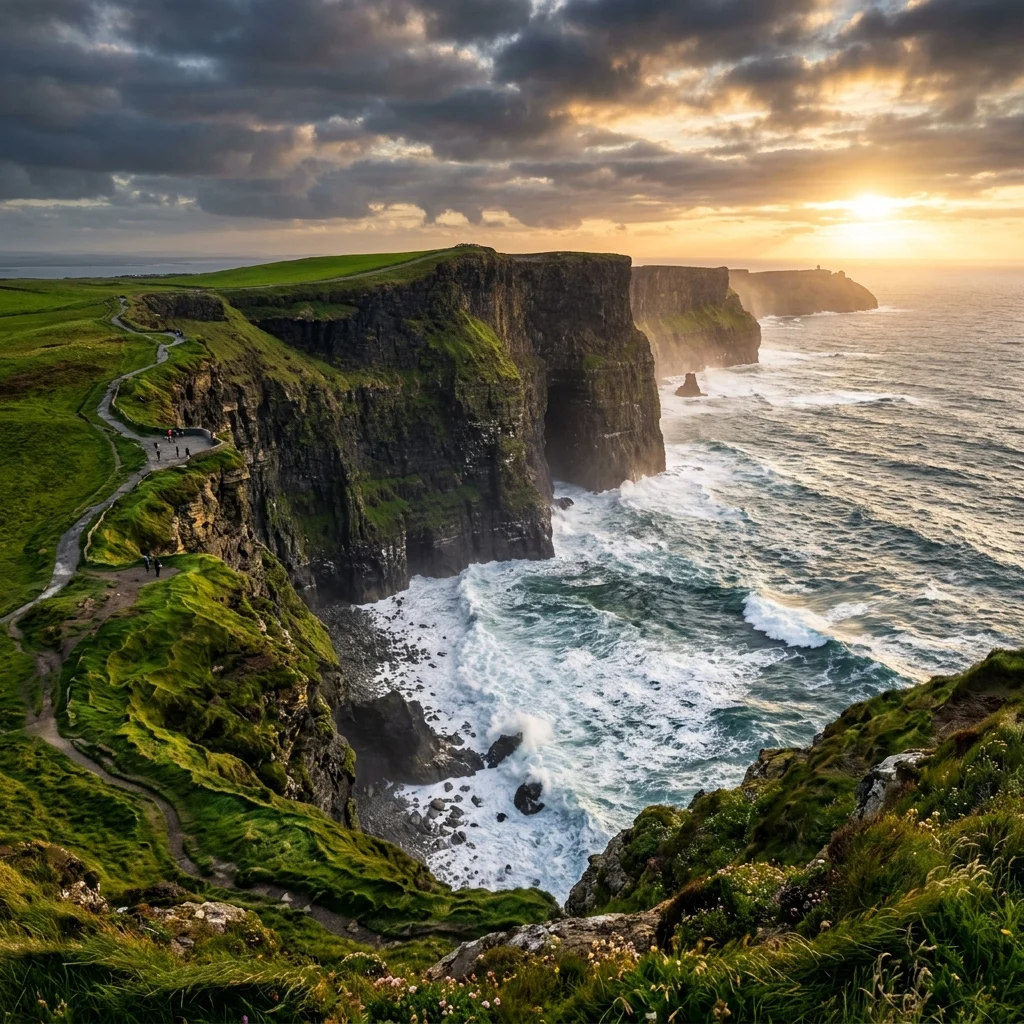
1. Slieve League Cliffs: The Highest Point of Your Wild Atlantic Way Journey
When people think of tall cliffs in Ireland, they usually think of the Cliffs of Moher. However, any thorough Wild Atlantic Way journey must start with the Slieve League Cliffs in County Donegal.
These majestic cliffs are actually almost three times higher than their famous cousins in Clare. Reaching almost 2,000 feet above the raging ocean below, they are among the highest marine cliffs in Europe.
Standing at the viewing platform at Slieve League is a humbling experience and a definitive highlight of any Wild Atlantic Way journey. The sheer scale of the rock faces plunging into the sea is completely breathtaking.
For the more adventurous, a hike along the ‘One Man’s Pass’ offers even more spectacular views. It is a highly recommended addition to your Wild Atlantic Way journey if you have a good head for heights.
2. Achill Island: The Jewel of Mayo
As your Wild Atlantic Way journey continues south into County Mayo, you must cross the bridge to Achill Island. This is the largest island off the coast of Ireland and an absolute paradise for nature lovers.
Achill is famous for its incredible beaches, most notably Keem Bay. This horseshoe-shaped bay, surrounded by steep cliffs, consistently ranks as one of the most beautiful beaches in the world.
A Wild Atlantic Way journey through Achill also offers a glimpse into history. You can explore the fascinating Deserted Village at Slievemore, consisting of over 80 ruined stone cottages abandoned during the Great Famine.
Whether you want to try surfing, hike up Mount Croaghaun, or simply relax on pristine white sand, Achill Island is an essential stop on a Wild Atlantic Way journey.
3. Connemara National Park: A Wild Beauty
Entering County Galway on your Wild Atlantic Way journey means entering the rugged, mystical landscape of Connemara. This region is famous for its hauntingly beautiful bogs, dark lakes, and the towering Twelve Bens mountain range.
Driving through Connemara is often cited as the most scenic portion of a Wild Atlantic Way journey. The light here changes constantly, casting incredible shadows across the mountains and valleys.
Be sure to stop at Kylemore Abbey, a stunning neo-Gothic castle built right on the edge of a tranquil lake. The contrast between the elegant architecture and the wild surrounding nature is perfectly representative of a Wild Atlantic Way journey.
Connemara is also a strong Gaeltacht area. Stopping for lunch in a local village here offers a wonderful chance to hear the Irish language spoken naturally, adding a beautiful cultural layer to your Wild Atlantic Way journey.
4. The Cliffs of Moher: An Iconic Stop
No Wild Atlantic Way journey is complete without a visit to the world-famous Cliffs of Moher in County Clare. They are the most visited natural attraction in Ireland for a very good reason.
Rising over 700 feet above the crashing waves, these majestic cliffs stretch for over five miles along the coast. Standing at the edge and looking out over the Aran Islands is a classic Wild Atlantic Way journey experience.
Because they are so famous, it is highly recommended to visit early in the morning or late in the evening. This allows you to experience the awe-inspiring beauty of this Wild Atlantic Way journey highlight without the massive crowds.
Don’t forget to visit O’Brien’s Tower, built in 1835 as an observation point for the hundreds of Victorian tourists who were already taking their own version of a Wild Atlantic Way journey.
5. The Ring of Kerry: A Journey Within a Journey
As you reach the southern sections of your Wild Atlantic Way journey in County Kerry, you will encounter the famous Ring of Kerry. This is a spectacular 111-mile circular route around the Iveragh Peninsula.
The Ring of Kerry is often considered a mini Wild Atlantic Way journey in itself. It takes you through mystical landscapes, sparkling lakes, dense forests, and incredible coastal viewpoints.
Highlights of this section of your Wild Atlantic Way journey include the stunning Killarney National Park, the dramatic Gap of Dunloe, and the picturesque Ladies View.
The route is dotted with charming towns and historical monuments. Taking a full day to explore the Ring of Kerry is an absolute necessity for any comprehensive Wild Atlantic Way journey.
6. The Dingle Peninsula: The Edge of the World
Just north of the Ring of Kerry lies the Dingle Peninsula, another spectacular highlight of any Wild Atlantic Way journey. National Geographic once famously described it as ‘the most beautiful place on earth.’
Driving the Slea Head Drive on the Dingle Peninsula offers some of the most dramatic coastal views of your entire Wild Atlantic Way journey. The narrow, winding road clings to the edge of the cliffs, offering panoramic views of the Blasket Islands.
The town of Dingle itself is incredibly vibrant, famous for its brightly colored pubs and fantastic seafood. Ending a long day on your Wild Atlantic Way journey with fresh fish and traditional music in Dingle is perfection.
This peninsula truly feels like the edge of the world, making it an unforgettable part of your Wild Atlantic Way journey.
7. The Skellig Islands: A Star Wars Filming Location
If you are taking a Wild Atlantic Way journey, a boat trip to the Skellig Islands is an absolute must, weather permitting.
These two towering, jagged crags rise out of the ocean off the coast of Kerry. Skellig Michael, the larger of the two, features an ancient monastic settlement perched at the very summit.
Climbing the hundreds of steep, ancient stone steps to the top is one of the most physically demanding but spiritually rewarding parts of any Wild Atlantic Way journey.
In recent years, the island gained global fame as the filming location for Luke Skywalker’s hideout in the Star Wars sequel trilogy.
Because access is strictly limited to protect the fragile environment, booking a boat tour well in advance is essential for this leg of your Wild Atlantic Way journey.
8. The Beara Peninsula: The Path Less Traveled
While the Ring of Kerry gets most of the tourist traffic, the neighboring Beara Peninsula offers a much quieter, wilder experience for your Wild Atlantic Way journey.
Shared by both County Kerry and County Cork, the Beara Peninsula features winding mountain passes and stunning, isolated coastline.
It is highly recommended for those who want to escape the tour buses and experience a deeply serene section of their Wild Atlantic Way journey.
Be sure to drive the Healy Pass, a winding mountain road that offers incredible panoramic views of Bantry Bay and the surrounding mountains.
The Beara Peninsula represents the true, untamed spirit of the Wild Atlantic Way journey.
9. Mizen Head: The Most Southwesterly Point
As you near the end of your Wild Atlantic Way journey, you must stop at Mizen Head in County Cork, Ireland’s most southwesterly point.
The visitor center here is located on a dramatic cliff edge. To reach the actual signal station, you have to cross an incredible suspension bridge spanning a deep, churning gorge.
Looking down into the gorge, you can often spot seals playing in the water below. It is a thrilling highlight of a Wild Atlantic Way journey.
The exhibition inside the signal station details the fascinating maritime history of the area, including the incredible story of the Fastnet Lighthouse.
Standing at Mizen Head, looking out at the endless ocean, provides a powerful moment of reflection on your incredible Wild Atlantic Way journey.
10. Kinsale: The Colorful Culinary Capital
Your incredible Wild Atlantic Way journey officially concludes (or begins) in the beautiful coastal town of Kinsale in County Cork.
Kinsale is famous for its brightly painted buildings, narrow winding streets, and its well-deserved reputation as the culinary capital of Ireland.
After weeks of driving, concluding your Wild Atlantic Way journey with a Michelin-starred meal or a massive bowl of fresh seafood chowder is the perfect finale.
You can also explore Charles Fort, a massive, star-shaped 17th-century fortress that guards the harbor.
Kinsale is a beautiful, welcoming, and delicious place to rest and reflect on the memories you have made on your unforgettable Wild Atlantic Way journey.
Tips for Driving Your Wild Atlantic Way Journey
To get the absolute most out of your Wild Atlantic Way journey, you need to be prepared. Driving in rural Ireland can be quite different from driving elsewhere.
First, take your time. A Wild Atlantic Way journey is not a race. The roads are often very narrow, winding, and shared with sheep, tractors, and cyclists.
Second, be prepared for ‘four seasons in one day’. The weather on a Wild Atlantic Way journey is notoriously unpredictable. Pack layers and a very good rain jacket.
Third, fill up your petrol tank whenever you get the chance. In some of the more remote sections of your Wild Atlantic Way journey, petrol stations can be few and far between.
Finally, allow yourself to get wonderfully lost. While having an itinerary is great, the best moments on a Wild Atlantic Way journey often happen when you take a random detour down a narrow country lane.
Conclusion: The Enduring Magic of the Wild Atlantic Way
Completing a Wild Atlantic Way journey is an achievement you will remember for the rest of your life. It is a profoundly moving experience that connects you deeply to the wild, natural world.
From the dizzying heights of Slieve League to the lively pubs of Dingle, a Wild Atlantic Way journey offers an incredibly diverse range of experiences. It is a road trip that truly has something for everyone.
We hope this guide helps you plan your ultimate Wild Atlantic Way journey. Remember to embrace the unpredictable weather, talk to the locals, and take plenty of photographs.
For more detailed maps and route planning tools, be sure to check out Tourism Ireland to make your Wild Atlantic Way journey absolutely perfect.